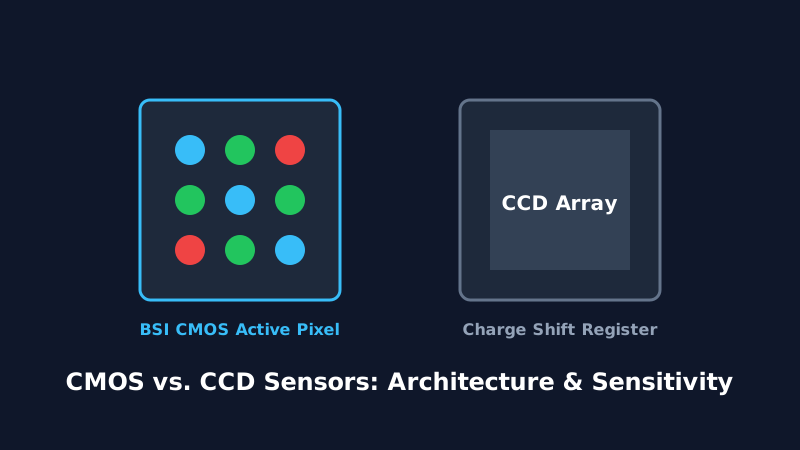
At the heart of every digital WiFi HD camera is the image sensor—the silicon chip that captures light focused by the lens and transforms it into digital video. In the security camera marketplace, you will frequently see references to CMOS and CCD sensor technologies.
While CCD historically held the crown for low-noise studio video, modern advancements in Back-Illuminated (BSI) CMOS sensors have completely revolutionized home and commercial video surveillance. Here is everything you need to know about the differences.
1. What is an Image Sensor in an IP Camera?
When light passes through a camera lens, it hits a rectangular silicon wafer covered with millions of light-sensitive photodiode wells. Each well converts photon energy into electrical charge. The fundamental difference between CCD and CMOS is how that electrical charge is read out and digitized into video frames.
2. Charge-Coupled Device (CCD): Legacy Strengths
In a CCD sensor, every pixel's charge is shifted across the silicon chip row by row and converted into voltage by a single output node at the corner of the array.
- Pros: High dynamic uniformity, zero rolling shutter distortion (Global Shutter), low fixed-pattern noise.
- Cons: Requires complex support circuitry; consumes 5x to 10x more electrical power; cannot be integrated onto battery-powered or solar wireless cameras.
3. CMOS (Active Pixel Sensor): The Modern Dominance
In a CMOS (Complementary Metal-Oxide Semiconductor) sensor, each individual pixel contains its own dedicated photodiode, amplifier, and readout circuit. This allows pixel data to be digitized simultaneously and in parallel.
- Ultra-Low Power Draw: Consumes a fraction of the milliwatts needed by CCDs, making wire-free battery cameras possible.
- High-Speed Processing: Supports ultra-fast 60fps / 120fps video and on-chip HDR processing.
- System-on-Chip Integration: ISP, HDR, and AI neural processors can be integrated directly on the same silicon die.
4. Direct Feature Comparison Table
| Feature | CMOS Sensor (Modern Standard) | CCD Sensor (Legacy / Industrial) |
|---|---|---|
| Power Consumption | Very Low (Ideal for battery & solar) | High (Generates substantial heat) |
| Low-Light Color Video | Exceptional (with BSI / STARVIS) | Good, but requires external IR lighting |
| Shutter Type | Electronic Rolling Shutter | Global Shutter (Frame Transfer) |
| Onboard AI & HDR | Native real-time integration | Requires external processing DSP |
| Cost-to-Performance | Excellent (Affordable 2K/4K) | High manufacturing cost |
5. The Rise of Back-Illuminated (BSI) & Sony STARVIS Sensors
In traditional front-illuminated sensors, metal wiring ran across the front of the photodiode layer, blocking up to 30% of incoming light. Modern WiFi security cameras utilize Back-Illuminated (BSI) CMOS sensors (such as Sony STARVIS and OmniVision PureCel), which place the wiring underneath the photodiodes.
This design allows nearly 100% of light to strike the silicon, delivering vivid, full-color nighttime security video under simple ambient street lighting without requiring blinding white floodlights!